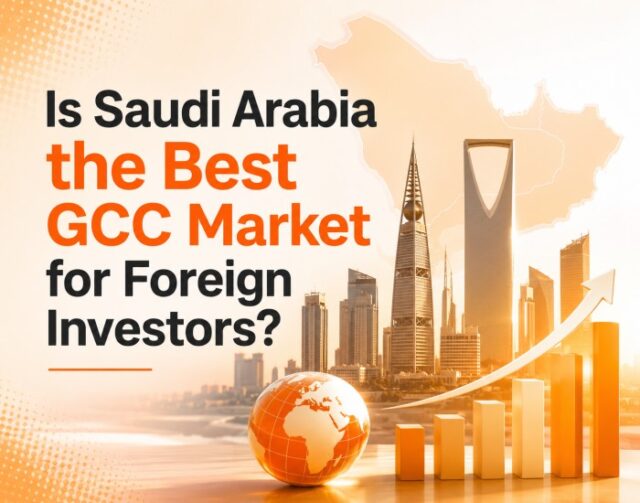
Every serious conversation about global investment destinations eventually turns to the Gulf. And within that conversation, one question keeps surfacing with increasing urgency — which GCC market is best for foreign investors looking for scale, stability, and long-term returns? The answers have shifted considerably over the past few years. What was once a straightforward comparison has become a genuinely competitive landscape, with Saudi Arabia emerging as the frontrunner in ways that few predicted even a decade ago.
This is not hype. The numbers, the policy shifts, and the sheer scale of what is being built inside the Kingdom make a compelling case that Saudi Arabia is not just competing for foreign capital — it is actively redefining what the GCC market expects from its most ambitious member.
The GCC Investment Landscape: A Quick Orientation
The Gulf Cooperation Council brings together six economies — Saudi Arabia, the UAE, Qatar, Kuwait, Bahrain, and Oman — each with its own regulatory environment, economic priorities, and investment proposition. For foreign investors, navigating this landscape has historically meant defaulting to the UAE, particularly Dubai, as the path of least resistance.
That default is being seriously challenged now. The GCC market as a whole has matured, diversified, and grown considerably more sophisticated in how it courts international capital. But within that group, Saudi Arabia’s trajectory stands apart — in ambition, in scale, and increasingly, in execution.
Why Saudi Arabia Is the Best GCC Market for Investors
The Vision 2030 Effect
No discussion of business setup in Saudi Arabia is complete without acknowledging Vision 2030, the Kingdom’s sweeping economic reform programme launched in 2016. What began as a bold policy document has translated into tangible structural change across nearly every sector of the Saudi economy.
Foreign ownership laws have been overhauled. Sectors that were entirely closed to international investors — entertainment, tourism, retail, renewable energy — are now open, actively incentivised, and attracting serious capital. The Saudi government has not merely announced reform; it has built the institutional infrastructure to deliver it, through bodies like the Ministry of Investment of Saudi Arabia (MISA), which has become a genuine one-stop facilitation engine for incoming investors.The result is an investment environment that looks meaningfully different from what existed five years ago — and is still improving.
Scale That No Other GCC Member Can Match
Saudi Arabia’s GDP is the largest in the GCC market by a significant margin, accounting for roughly half of the region’s total economic output. Its population of over 35 million — the largest in the Middle East— represents a domestic consumer market that simply does not exist at comparable scale anywhere else in the Gulf.
For investors whose thesis depends on domestic demand, this matters enormously. The UAE’s strengths are real, but its population base is small and heavily dependent on expatriates. Saudi Arabia offers something different — a young, growing, increasingly empowered domestic consumer class with rising disposable income and rapidly shifting consumption patterns.
This is the structural argument for Saudi Arabia as the best GCC market for foreign investors thinking beyond trading hubs and logistics plays.
Saudi Arabia vs UAE for Business: An Honest Comparison
The Saudi Arabia vs UAE for business debate is one of the most frequently asked questions among investors approaching the Gulf for the first time. Both deserve serious consideration, and neither is the universal answer for every investor profile.
The UAE — Dubai in particular — offers an unmatched ecosystem for regional headquarters, financial services, logistics, and businesses that prioritise international connectivity and a cosmopolitan operating environment. Its regulatory infrastructure is mature, its free zones are globally recognised, and its lifestyle proposition attracts senior talent with relative ease.
Saudi Arabia, by contrast, offers something the UAE cannot — direct access to the Kingdom’s vast domestic economy. The Saudi government has made it increasingly clear that companies wanting to benefit from Saudi contracts, Saudi procurement, and Saudi public spending will need a meaningful presence inside the country, not just a regional office in Dubai. The Regional Headquarters Programme, which offers significant incentives to multinationals that base their regional HQ in Riyadh, is one direct expression of this policy.
For investors whose model requires deep integration with the Saudi economy — in sectors like construction, healthcare, education, energy, manufacturing, or technology — business setup in Saudi Arabia is not just preferable. It is increasingly necessary.
Stability in a Region Under Pressure
One factor that does not always make it into investment brochures but weighs heavily in boardroom risk assessments is geopolitical stability. The Middle East has faced its share of tensions in recent times, and investor confidence in the broader region has at times been tested.
Saudi Arabia’s position here is worth noting carefully. While regional tensions have periodically affected sentiment across parts of the Gulf, Saudi Arabia has consistently demonstrated the capacity to insulate its economic agenda from geopolitical disruption. The Kingdom’s diplomatic posture — including its active engagement in conflict de-escalation, its normalisation efforts with regional neighbours, and its strengthened bilateral ties with both Eastern and Western powers — has positioned it as one of the most geopolitically stable destinations within an otherwise complex neighbourhood.
For foreign investors, this relative insulation matters. Capital flows to certainty. And Saudi Arabia, more than most of its neighbours, has managed to project economic certainty even when the broader region has faced turbulence. It is one of the least affected economies in the GCC when it comes to translating regional tensions into actual disruption of trade, investment, or business operations. This track record deserves more weight than it typically receives in risk assessments.
Sectors Leading the Opportunity
Understanding where Saudi Arabia’s investment case is strongest helps investors focus their analysis. Several sectors stand out within the current reform cycle:
- Tourism and Entertainment: NEOM, Red Sea Global, Diriyah — these are not concept projects. They are live, funded, and advancing. Saudi Arabia’s tourism sector is growing from a near-zero baseline, which means the upside for early investors in hospitality, entertainment, and supporting infrastructure is substantial.
- Renewable Energy: Saudi Arabia has committed to generating fifty per cent of its electricity from renewables by 2030. Given the Kingdom’s solar resources and the scale of investment being directed at this sector, it represents one of the clearest long-term plays in the entire GCC market.
- Manufacturing and Logistics: Saudi Arabia’s geographic position — connecting Asia, Africa, and Europe — combined with its infrastructure investment, makes it a credible manufacturing and logistics hub. Special Economic Zones offering competitive tax and ownership structures have been introduced specifically to attract this category of investment.
- Technology and Digital Economy: Riyadh is positioning itself as a regional technology capital. Cloud infrastructure, fintech, e-commerce, and AI investment are all actively courted, with government programmes providing both financial incentives and regulatory sandboxes for innovation.
What the Numbers Say
Foreign direct investment into Saudi Arabia has grown substantially since the launch of Vision 2030 reforms. MISA has reported consistent year-on-year growth in new investor licences and FDI inflows, with the government targeting FDI of 388 billion riyals annually by 2030. This figure would represent a fundamental transformation of the Kingdom’s economic composition.
This is the best GCC country for business arguments made in hard numbers. The target is ambitious, but the policy machinery being deployed to achieve it is serious and well-resourced.
Practical Realities of Setting Up
For all its opportunities, business setup in Saudi Arabia requires careful preparation. The regulatory environment, while significantly improved, has its own requirements — commercial registration, sector-specific licences, Saudisation compliance under the Nitaqat programme, and documentation standards that must be met precisely.
Foreign investors who have done business in the UAE and expect an identical experience will find differences. Saudi Arabia’s system rewards thorough preparation and, increasingly, those who engage proper local support. Understanding the documentation chain — from commercial registration through attestation requirements to licence approvals — before beginning the process saves significant time and avoids costly restarts.
The Verdict
The best GCC market for foreign investors is not a single answer for every investor. But for those looking at scale, long-term domestic market access, government-backed sector transformation, and a regulatory environment that is actively improving — Saudi Arabia makes a case that is increasingly difficult to argue against.
The UAE will remain the Gulf’s preferred gateway for regional headquarters, financial services, and businesses built on international connectivity. But Saudi Arabia is no longer simply the large neighbour with oil wealth. It is an economy in active transformation, with the policy will, the financial firepower, and the domestic market scale to back up its ambitions.
For investors willing to engage with the Kingdom on its own terms — understanding its regulatory landscape, respecting its documentation requirements, and committing to genuine on-the-ground presence — the opportunity is as large as anywhere in the GCC market right now.
Enter Saudi Arabia smoothly with Helpline Group.
Entering Saudi Arabia as a foreign investor involves more than a business plan. It involves navigating commercial registration, licence approvals, document attestation, and compliance requirements across multiple government touchpoints.
Helpline Group brings over 25 years of experience in this space, having supported more than 10,000 business setups across the Middle East through a network of 10+ international branches — making it one of the most established names in business facilitation across the region. That depth of experience means we understand not just the paperwork, but the practical realities of what it takes to establish and sustain a compliant business presence in Saudi Arabia and beyond.
We provide end-to-end support for investors and businesses establishing a presence in Saudi Arabia — from documentation and attestation services to guidance through the regulatory setup process.
If you are evaluating business setup in Saudi Arabia or comparing your options across the best GCC country for business, speak to our team. We help you move from decision to operational presence with accuracy and efficiency.