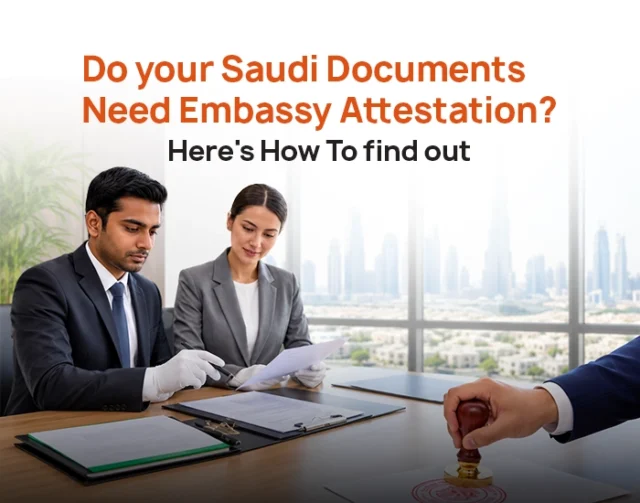
A few years ago, document legalisation in Saudi Arabia usually meant one clear route: local verification, MOFA attestation, and then embassy attestation. But today, the process is not always the same. Since Saudi Arabia is part of the Hague Apostille Convention, many documents may now be accepted with Apostille instead of traditional embassy legalisation.
This is why people often get confused. Do you need embassy attestation in Saudi Arabia, or is Apostille enough? The answer depends on where the paper will be used, what type of document it is, and whether the destination country is also a member of the Hague Apostille Convention.
What Is Embassy Attestation in Saudi Arabia?
Embassy attestation in Saudi Arabia is the process of verifying a document through the country’s office or consulate where the paper will be used.
For example, if a Saudi-issued document must be submitted in a non-Hague country, that country’s embassy in Saudi Arabia may ask for final attestation after Saudi-side verification.
Is Embassy Attestation Always Required Now?
No. Embassy attestation is no longer always required.
Because Saudi Arabia is a Hague Apostille member, documents used between Saudi Arabia and another Hague Apostille member may only need an Apostille instead of embassy attestation.
| Situation | Common Requirement |
| Saudi document for use in a Hague member country | Apostille may be enough |
| Saudi document for use in a non-Hague country | Embassy attestation may be required |
| Foreign Hague country document for use in Saudi Arabia | Apostille may be accepted |
| Foreign non-Hague country document for use in Saudi Arabia | Saudi embassy attestation may be needed |
What Is Apostille and How Is It Different?
An Apostille is a simplified form of document legalisation used between countries that are part of the Hague Apostille Convention. It verifies the signature, seal, or authority of a public document.
Embassy attestation, on the other hand, is the traditional legalisation process through the destination country’s embassy or consulate.
So, if both countries are Hague members, Apostille can often replace embassy attestation in Saudi Arabia. But if the destination country is not a Hague member, embassy attestation services may still be required.
Which Saudi Documents May Need Apostille or Attestation?
- Educational certificates
- Birth certificates
- Marriage certificates
- Commercial documents
- Power of attorney
- Experience certificates
- Salary certificates
- Company documents
- Court or legal documents
How Do You Know Which Process You Need?
The easiest way is to ask one question first: where will the document be used? You should also check:
- Is the destination country a Hague Apostille member?
- Is the document personal, educational, or commercial?
- Has the right Saudi authority verified the document?
- Does it need ratification by the Saudi MOFA first?
- Does the receiving authority ask for embassy legalisation?
- Is Arabic or certified translation required?
These small checks can save time, money, and rejection.
When Is Saudi Embassy Attestation Still Needed?
Embassy attestation in Saudi Arabia is usually required when a foreign document from a non-Hague country needs to be used in Saudi Arabia.
For example, if a degree certificate, marriage certificate, or commercial document is issued in a country that is not part of the Apostille Convention, it may need home-country verification, Saudi Embassy attestation, and Saudi MOFA attestation after arrival in Saudi Arabia.
This is why the term “Saudi Embassy attestation” remains important, even after Saudi Arabia joined the Hague Apostille Convention.
What Is the General Process?
- Document checking
- Verification by the issuing authority, if required
- Apostille from the competent authority
- Translation, if required
- Submission to the receiving authority
For non-Hague countries:
- Document checking
- Local authority verification
- MOFA attestation
- Embassy or consulate attestation
- Final review and submission
Why Do Documents Get Rejected?
Documents may get rejected because the wrong process was followed. Common reasons include:
- Apostille used for a non-Hague country
- Embassy attestation done when Apostille was required
- Missing MOFA ratification
- Wrong document category
- Name mismatch
- Missing translation
- Damaged certificate
- Incomplete supporting documents
The safest way is to check the right route before submission.
Helpline Group – Let Your Documents Move the Right Way
Every document has a purpose. It may support a job, a family visa, a business deal, a higher education plan, or a migration journey. One wrong attestation route can delay an important life decision.
With 28 years of expertise, 10 international branches, and service experience across 100+ countries, Helpline Group stands beside you with clarity, care, and trusted support.
If you are unsure whether your Saudi document needs an Apostille or embassy attestation in Saudi Arabia, let Helpline Group help you choose the right path and move forward with confidence.